Blog
Check Stripe Radar → Monitoring
Check Stripe Radar → Monitoring. If you haven’t looked at this dashboard, that’s the first thing to fix. Part One is linked here.
Stripe’s certification course describes Visa’s VDMP and VFMP monitoring programs. Both were consolidated away in 2025. So I went to read the current program documentation. What I found is that the number most merchants quote isn’t the number that governs them.
The ratio people quote is not the whole picture
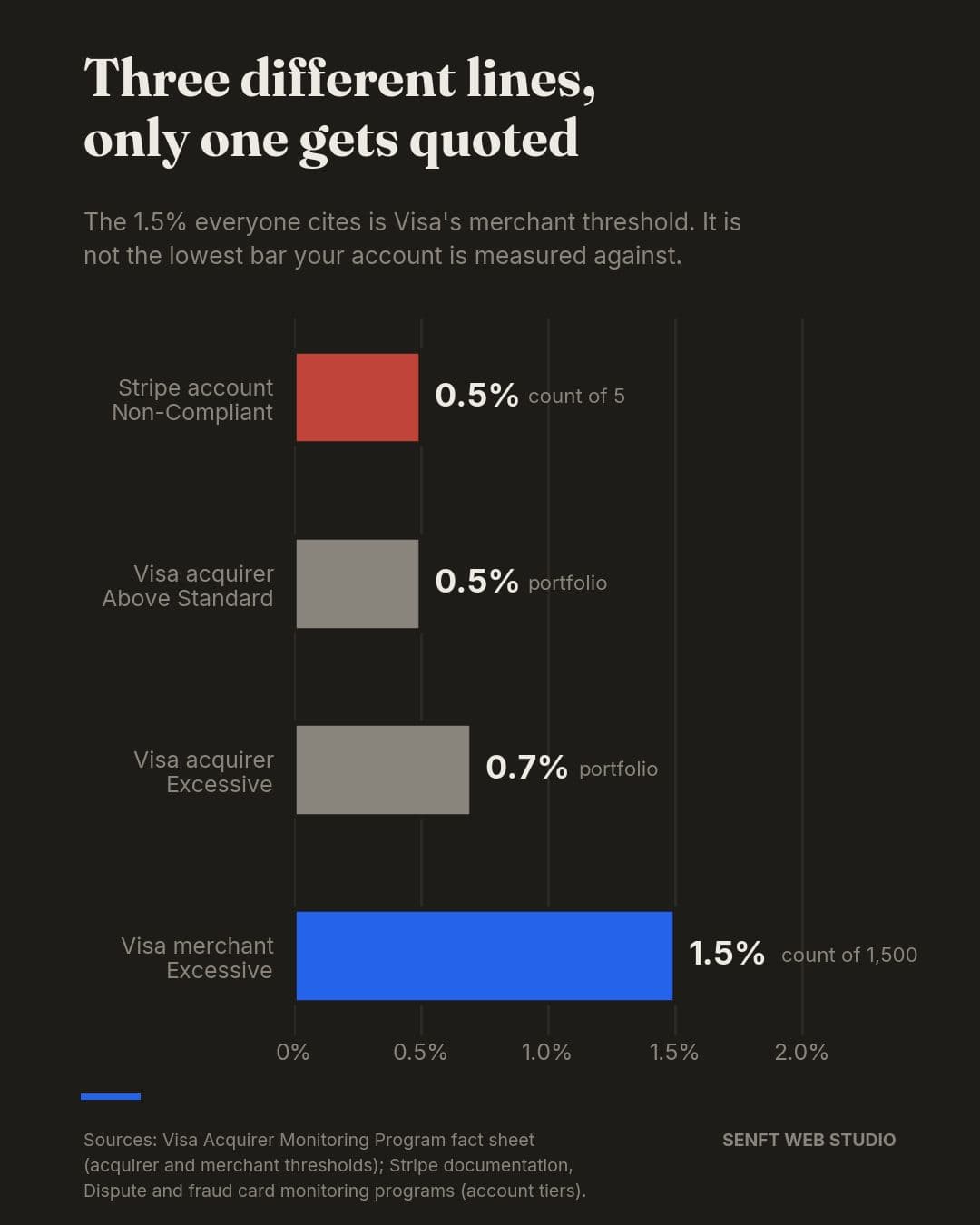
VAMP replaced both programs. One ratio: Visa’s TC40 fraud reports plus TC15 disputes, over settled card-not-present transactions. The figure everyone cites is the Excessive Merchant threshold, at 1.5%, down from 2.2% on April 1, 2026, with a floor of 1,500 combined fraud and dispute events per month. Under that floor, the usual summary goes, you’re not monitored.
Two things complicate that.
First, the merchant threshold is conditional. Visa’s fact sheet says the Excessive Merchant thresholds apply if the acquirer is not itself Above Standard or Excessive. Acquirer portfolios are measured at 0.5% and 0.7%—far tighter than the merchant line. Your ratio is an input to theirs.
Second, your processor sets its own bar. Stripe’s documentation lists a Non-Compliant tier for accounts at a VAMP count of 5 and a ratio of 0.5%. Five events. That mirrors the acquirer-portfolio number, not the merchant one. Being under Visa’s merchant floor does not mean nobody is counting.
Three mechanics that make the count climb faster than expected
- Early fraud warnings count. They aren’t disputes, and Stripe doesn’t include them in your dispute rate—but Visa’s VAMP calculation does, regardless of outcome.
- One transaction can count twice. Stripe’s docs say it directly: a transaction appearing in both the TC40 and TC15 reports is counted twice.
- Refunding mostly doesn’t undo it. Monitoring programs don’t consider refunds when identifying disputes, and refunding a flagged payment doesn’t retract the fraud report. The one exception is a refund processed as a reversal, usually within about two hours of capture.
The lever that does work is upstream
Per Stripe: issuers are required to report suspected fraud on a captured payment even if you refund it. But they aren’t required to report it on an authorization. Reverse it before capture and it’s never reported at all.
Do you know the right levers to pull to protect your hard-earned revenue?
Sources
- Visa VAMP fact sheet (2025 edition; April 2026 threshold change in footnote 5).
- Stripe: card network monitoring programs.
- Stripe: how disputes work.
Ready to put this to work?
Start with the processor configuration, fraud signals, and payment evidence already in place before deciding what to optimize.